
Closing the Loop: What Our Team Did When We Found Out Where Our Compost Really Went

By Leslie Connolly, Kindergarten Teacher, Bernice Ray School

For years, our school composted the right way. Food scraps went to a local farm, became nutrient-rich soil, and students and staff had agency in doing something good for the environment. Then our ECAP team of Sophie Doiron, Lynn Cutting, Michelle Landry, and I (in kindergarten), Angela Hotvet (in first grade), and Bob Stone (in fifth grade), found out that our school's hauling contract had quietly changed, and our compost was going into a landfill.
When we discovered what was actually happening to our food scraps, we were dismayed. We were determined to get back to our original model, close the loop, and have our compost come back to our own school garden. As Michelle told her students, "instead of going to the landfill, it can go back to nature and use our resources in a way that can help the Earth."
With guidance from the amazing Cat Buxton of The Upper Valley Super Compost Project, we were able to design curriculum, audit our current compost output, learn from our colleagues at a neighboring school with a successful on-site composting program, and make a plan to overhaul our system.
We all agreed that in order for the project to work and be sustainable, we needed staff, students, and our administration on board. We chose to launch the project during Earth Week with K-5 composting lessons to generate enthusiasm for the idea. Students learned about the food recovery hierarchy, the amazing macro- and microscopic critters that do the work in the compost bin, and why composting is good for the environment.
What the kids actually did
One of the best parts of the project was the collaboration and cooperation between all of the participating classes. During the waste audit, kindergarteners and first graders weighed the compost each day for a week and recorded data. Fifth graders crunched all of the numbers and populated a spreadsheet to track the amount of food waste generated by each grade level, the school cafe, and the staff room.

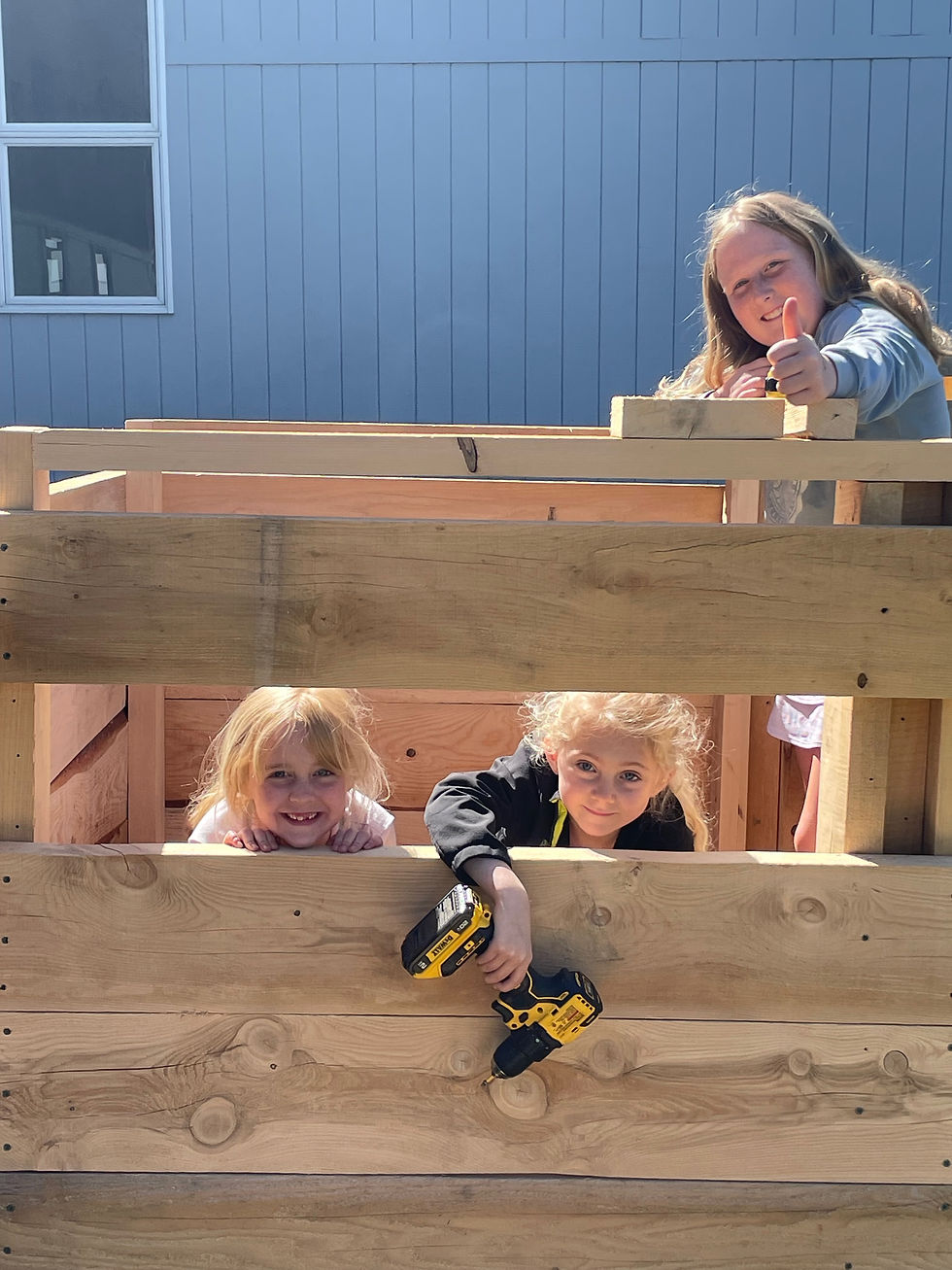
Once the kids had completed the waste audit, there was the task of figuring out what size bins we’d need to accommodate our composting system. This happened at the fifth grade level too. Finally, the best part of the project arrived…building our own bins, on site, with the kids. Not watching an adult build them. Building them. Our kindergarten students and their fifth grade mentors were out there with nail guns and drills, small hands on real tools, and it was the most rewarding part of the whole project. Kids learning hands-on skills from a carpenter from our community was a highlight of the project too.
Another exciting community connection came with a group of Hanover High School students. During Earth Week, The HHS Environmental Club came in to teach our elementary students about composting. Seeing our younger students accurately answer questions posed by the HHS club members was proof that our kids really understood the content and the importance of composting. Knowing that our school is a pilot for the district motivated us to connect with the High School students to help the project gain eventual momentum there too.
What we'd tell other teachers
Here's what we want other teachers to know: Taking on a project like this doesn't add more to your (already full!) plate. It just makes the work you have to do anyway more interesting and more relevant. It's a “funner” way to fill your plate.
It helps enormously to build capacity across grade levels rather than staying inside your own classroom. You don't need a perfect setup, and you don't need to do it alone or within one grade. We had a dismaying problem (our own compost going to a landfill) and a team spanning kindergarten through fifth grade worked together to find and implement a solution. If something's broken in your own school's systems, that might be your starting point too.
For more information, contact [leslie.connolly@rayschool.org at Bernice Ray School, or the Equitable Climate Action Project at uvtpc.com/hopefulstories or bit.ly/hopefulstories.


